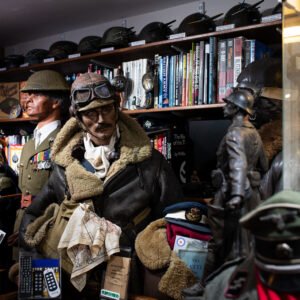
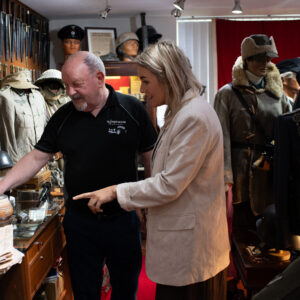

Some stories deserve to be told, and some collections deserve to be experienced. The Abingdon Collection is both.
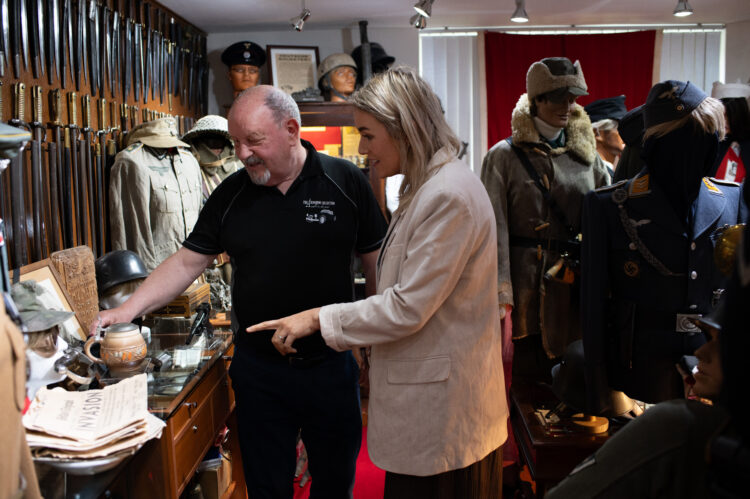
We are incredibly grateful to have had the opportunity to sit down with Philip Faithfull in his beautiful home, where the Abingdon Collection has grown over almost six decades into one of the most remarkable private collections of military history and automobilia in the country. Listening to Philip speak so passionately about the collection, it quickly becomes clear that this is far more than a museum—it is a lifetime’s work built on emotion, dedication, countless hours of research, and an extraordinary depth of knowledge.
From the very first bayonet that sparked a lifelong passion at the age of fourteen, to the thousands of carefully documented artefacts that now fill the collection, every item has a story, and every story has been preserved with remarkable care. Throughout our conversation, Philip shared not only the history behind the collection, but the personal memories, challenges and triumphs that have shaped it over the past 58 years.
We hope you enjoy hearing Philip’s story as much as we enjoyed listening to it.
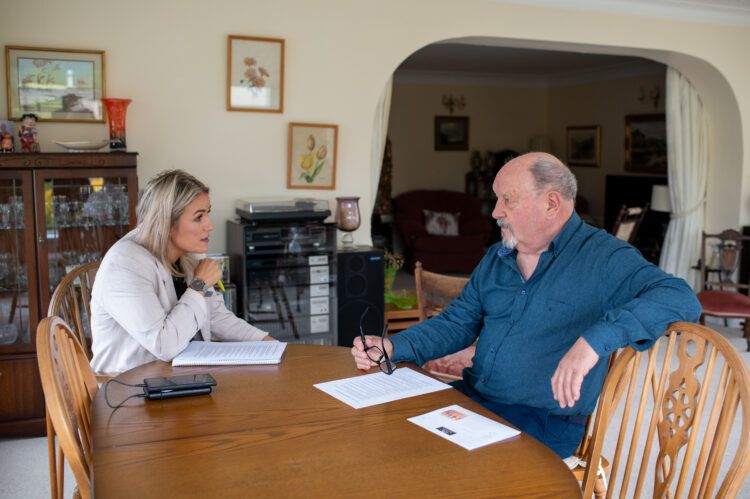
US – To start with Philip, for those who haven’t visited before can you tell us a little bit about the Abingdon Collection and what visitors can expect to see?
Philip: Well the first thing I suppose for me to say is that I’ve been collecting for 58 years, we opened the collection in 2006 to the public, and perhaps from small acorns it has grown dramatically, and it’s now become a fairly well-known tourist attraction.
For visitors coming it’s a unique experience, if you look at Trip Advisor we have over 300 5star reviews, and that’s been very very useful for us, people come once and tell other people, and next thing we’ve someone coming because they heard about it from a friend or seen it on Trip Advisor.
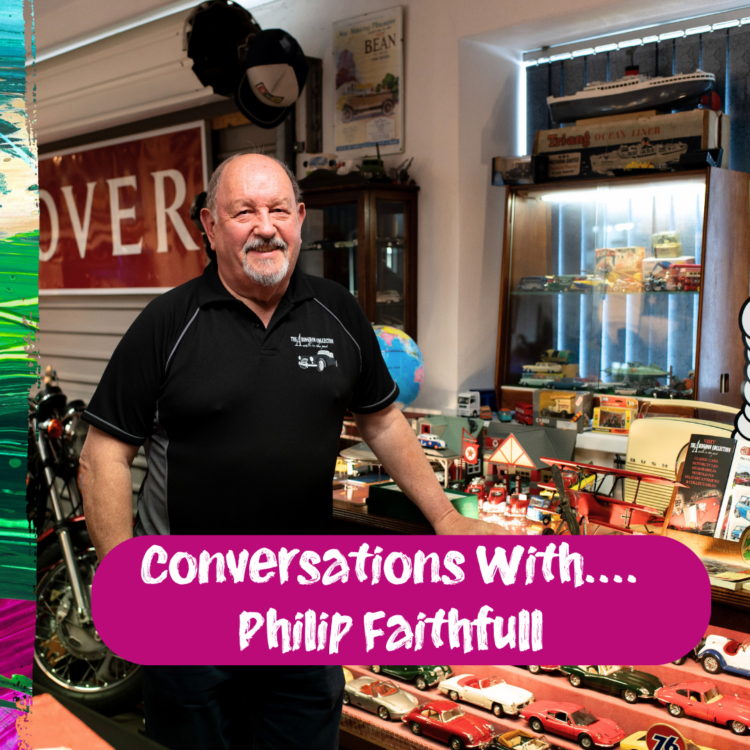
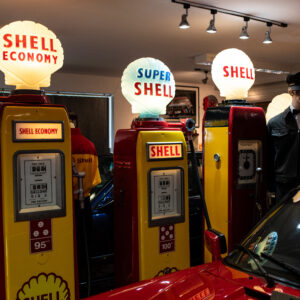
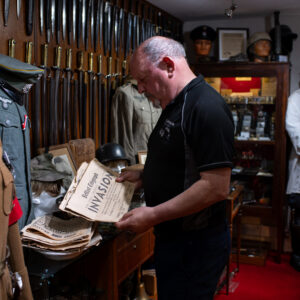
I started collecting military antiques and then went into the cars; motorcycles and enamel signs and so on over the years. This collection is fairly unique in that you’ve got a mixture between the automobilia side, the militaria side and its difficult for me to pinpoint another collection that actually does that outside the national collections, and these small collections rely on word of mouth and so on, and of course your own advertisement of it on Omagh and The Sperrins, which works very well for us. The collection is seven and a half thousand documented items here, and we’re bringing in about 300 extra items a year, from a simple military badge right up to a motorcycle, it just depends how the money goes.
We also do outreach, where we’re called into nursing homes and we do these memory talks, the whole essence of the Abingdon Collection is “A Walk in The Past”, so we’ll go into nursing homes take 60 items out and do memory talks, it’s amazing the difference they make, you’re talking about somebody who has basically lost their memories, it brings it back to them, it’s very rewarding to be involved in that.
Of course the collection has no income, all donations go to Cancer Research UK, that’s simply because my father, who was an ex-soldier for 23 years throughout the second world war died of lung cancer, the last three years of his life was absolutely terrible. So now at the end of the month the donations all go to Cancer Research.
Us – With regards to the collection Philip, 58 years of collecting, that’s unbelievable, where did your passion for collecting begin and what first sparked your interest in military history and automobilia?
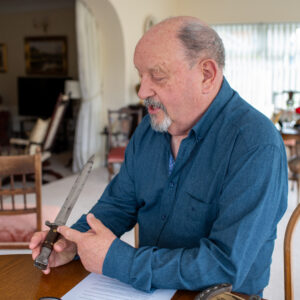
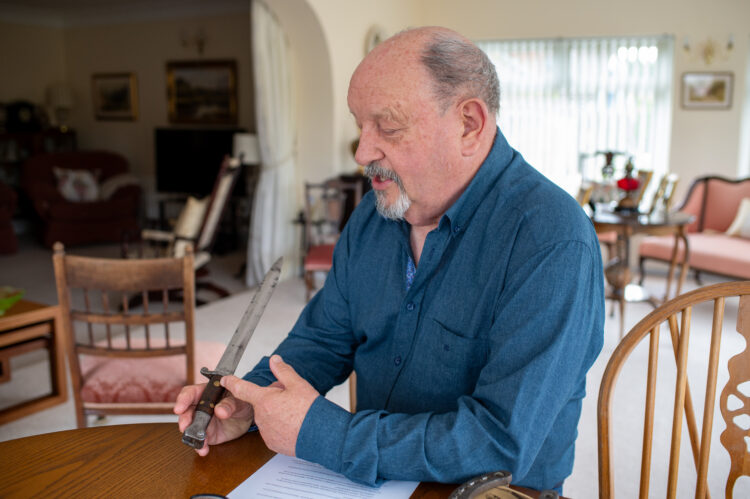
Philip – First of all if we look at the military history end of things you would expect me to say well my father was a professional soldier so therefore it came from that, it probably didn’t, like any veteran that was in the Second World War they never talked about it, what spurred me on to collect was one item, and I’ll just show you that now, this item is a Lee Metford Mark one bayonet, my father-in-law gave me that when I was 14, he found it in a loft in Donemana, in County Tyrone here, and this sparked the collection of military antiques, and now I’ve over 550 bayonets in the collection, I’d be fairly well known as a blades collector. Now I don’t want to get too technical on this but the reason this is so rare is that with the three studs on the handle here, during the heat of South Africa during the Boer War, that handle cracked so they moved the two studs so it makes this the rarest of all British Bayonets, and it just so happened to be the first bayonet I was ever given. If the house went on fire this is the one thing I would take out of the collection, simply because Hazel, my wife and I have been together since we were 14, and now we’re 47 years married – this is the thing that started the whole collection.
This was pre internet, so you’re talking about having to go to the library or to buy a book and to research, and from then on I was sort of 15, 16 and I very soon knew this was a rare bayonet. From then on I started to collect bayonets. By the time I was 17, I had 30, by the time I was 30 I had 200. You have to specialise in something and bayonets to me were an easy way to specialise, it’s strange when you look at it now, particularly with the knife crime, you wouldn’t think about giving a kid a bayonet or a knife, but the thing about it is, it’s knowledge. It’s not what the weapon represents in terms of war, it’s being able to look at the history of that weapon and look beyond the blade. The bayonet is the last line of defence for the common soldier, once the ammunition is gone they’re left with the bayonet, and that’s why it’s so important for me when we’re talking to groups and kids in particular, that we’re talking about how these are not toys. These are to be used only in conflicts. It’s so important that we teach this. So that started the military collection and it just grew and grew, you have to specialise, so from bayonets I started to specialise in WW2 and then started specialising particularly on the German side in WW2, because most of my friends when we’re doing the big shows, they would have British uniforms or American uniforms and so on, and there were very few of us specialising in German in particular. Luckily in the early stages when the veterans were still alive I was able to pick up some fantastic uniforms and the blades and swords and daggers. It’s probably the most expensive thing you can get into, the only way I can describe it to groups and to kids if you’re buying something German you have to decide have you the one piece of 100,000 out there, because that’s the way it is out there, the internet is just inundated with copies of German militaria.
In terms of the car collection and so on, I’ve been riding motorcycles since I was 16 so they were always part of my growing up phase. Then of course when you were 17, 18 you got into the cars and I was lucky to have some very good sports cars when I was a kid, that was me harassing my parents, the first car I bought was £50, and from then on it was into Austin Healey Sprites, MG and Ford Escorts. I did a bit of rallying but I wasn’t good enough. I always had a fascination for MG and Ford in particular.
Us – And you obviously know if something is genuine or not Philip, does that just come with time and experience or have you trained for that?
Philip: That’s a very good question and it’s one question I’m often asked. You have to have expertise in this, you can’t have expertise in everything, but almost on a monthly basis someone will bring me in a piece that is either fake or is original, and they are looking for me to identify if that’s fake or original. Now unfortunately I have often been brought in daggers and swords, which if original, would have been worth thousands only to have to explain that the items were produced in Spain in about 1986 and are worth about sixty pounds each.
People pass on and we get called in to break up big collections, so we go into the house and are asked to advise on that. We very rarely sell the collection, we would often buy out of that collection. Every piece that comes in here we can identify and advise on. We research and identify toys, militaria and automobilia. It’s rewarding but they are relying on you to get it right, and if you don’t get it right then you have problems. But we have a few very good contacts. And the same thing is going to happen here, and the thing about here is that it’s so well catalogued and because I’ve got the contacts, I may sell the collection before something happens.
Us – Does anyone ever donate to your collection?
Philip: We’ve very few donations, we don’t particularly like donations, and that sounds crazy, but if somebody offers me something I will always give them a monetary value, because there’s medals and so on that are particular to every family, and if they donate to me or to a museum that’s lost out of the family, and believe you me it happens every single day, even in Northern Ireland here.
Us – Looking back over more than 50 years Philip, did you ever imagine it would grow into what it is today?
Philip: (Philip gives a little chuckle at this question) No, it is like a business to me now unfortunately, and it was never intended to be that. You’ve got to remember, when I started this it was in one room of the house in Omagh, then we moved out here and it was in two rooms, then we added on the two garages, and we added on another room! It’s like any sort of small museum, we’re running at about 110% capacity at the minute, we can’t show everything, but we’re showing certainly a lot of items. It was never intended to be this, I was lucky enough to have good employment over the years with Omagh, Strabane and Derry Councils, so I was able to perhaps afford things at an early stage when they were fairly cheap. Now they’re not cheap, and now the collection has grown so much. I never intended to bring staff in, but now I’m having to bring staff in nearly every week. Next weekend we have two church groups, the following weekend we’ve the Mini club coming, and every time we have groups over 10 I have to bring a member of staff in. Also the amount of cleaning to be done! There are 85 glass cabinets to be cleaned here. There’s over 90 mannequins, and that means Hazel or myself cleaning those, and if you’ve got a group of 10 landing, no matter how good they are, they will always put hands on cars or hands on a glass cabinet. We add so much to the collection, I do the auction houses every week. Last weekend there was three very rare enamel signs that came out of the Ballymoney auctions. At the weekend I picked up a couple of pieces in Omagh at an auction, so you’ll always get those additional items coming in and filtering through into the collection. It was never intended to be this, it was never intended to be a business, it’s in the wrong location. If we were in the centre of town we would be inundated, you know, but thank God we are out in the country here. In April for example we put through about 300 people alone. Most small operators are not doing anything like that and that’s why we emphasise that its pre-booking only. It’s great craic as well, the only thing gets me is obviously I’m getting on a bit and I can’t do this anymore than twice a day now.
Us – The collection contains thousands of items, from both World Wars Philip, are there any exhibits that are particularly special or meaningful to you?
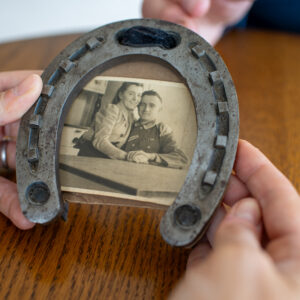
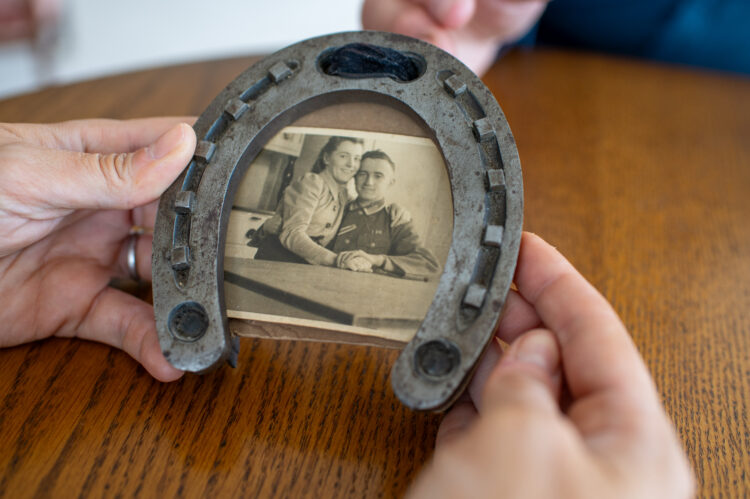
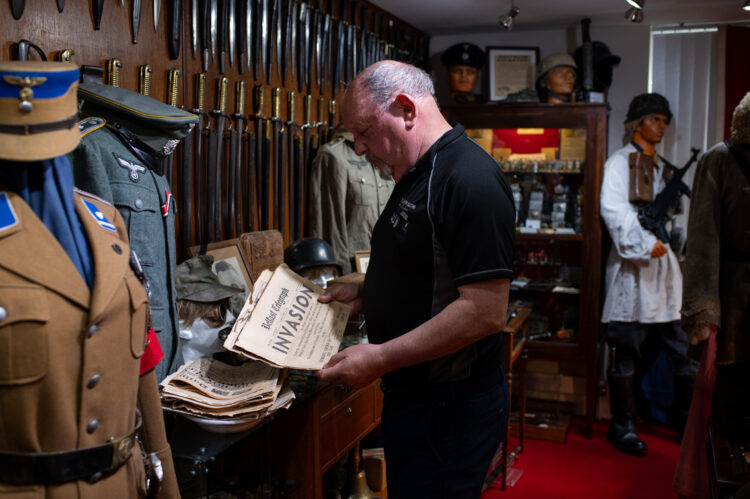
Philip: We were very lucky and probably in a very unique situation. In about 2009 I was called to a collection in Antrim, unfortunately the lady was in a nursing home and we were dealing with her daughter Margaret. I was expecting to go in there and look at two or three items of German interest, and we went in there were three suitcases on the table. This lady was German, she married a Sixth Cavalry Officer in 1942, and he died in October 1944. We had three suitcases that belonged to this family. After the war in the 1960s she moved to Northern Ireland and she wouldn’t leave the suitcases behind. She took them to Northern Ireland. So this is the love story between Anna and Emile. Anna Benz marries Emile Mayer in October ’42. They’ve no children from this marriage, and he dies in October ‘44 at Suwalki in Poland as a Sixth Cavalry Officer. Now this family’s history was forgotten for 55 years, and now we talk about him sometimes three times a day. When we went to the collection we opened the cases and his photograph were in it. His death plaque was in it, his sword was there, his drinking cup, his love letters that we had sent Anna from the Eastern Front in Poland Russia between 1942 and 1944. He was only home on leave for about 6 weeks during the whole of their marriage but she kept his medals and decoration. She kept his personal belongings, his uniforms and we have two of his uniforms on display. For Emile who died at 26 on the Eastern Front. Then we also have what was sent to her in 1944 – his personal belongings that were picked up after he died, because there was nobody ever going back home to Germany. We have his personal belongings which included and it sounds crazy but its boxed and it’s two tubes of toothpaste, a cigarette box, a hanky and playing cards. It’s all there but no body. This guy was forgotten for 55 years – this guy’s memories, the memory has to be remembered. He fought in combat, he died in combat, and now we’ve got his history. I write quite a bit and I tried to write this as a book. It’s probably going to go to a screenplay rather than a book, but we’ve got him getting married in Germany, fighting on the Eastern Front, and then after he died. Then in the 60s Anna coming back to Northern Ireland and marrying for the second time. It’s a love story between the two of them, and she kept his memory alive for 55 years. She kept them underneath the bed in a suitcase, and bringing German stuff back into NI in the ‘60s would not have been popular so that’s why they were hidden away for 55 years. That’s one very important feature of the collection – it’s a very very important story to be told and I need to tell it before I go off this planet.
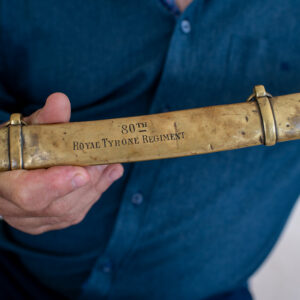
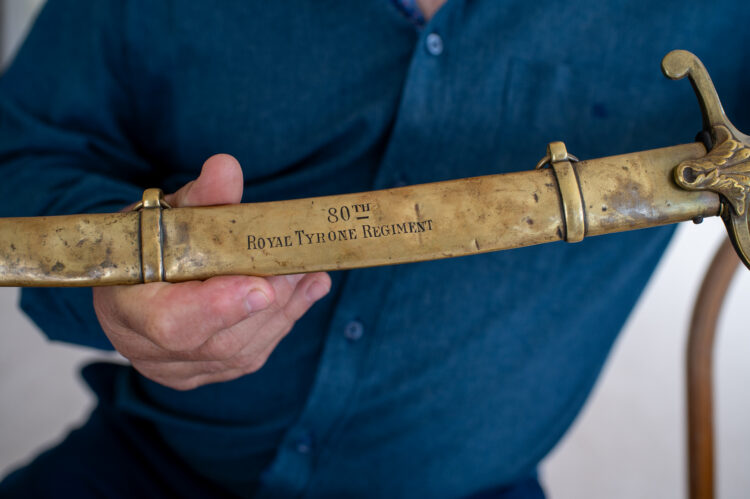
There’s one other very memorable find and if you don’t mind I’ll show you, (Philip strolls across the room and gently lifts a magnificent looking sword). Now, normally as I say I get people bringing stuff to me, and most of it is not original, this is original. This is probably the most important sword ever found in Omagh. This is for the 80th Royal Tyrone Regiment – a regiment that was raised in about 1796 in Omagh. This sword was found in a house in Omagh, and it was going to be sent to Belfast to a relative but this sword cannot go out of Omagh because it is of such relevance to the Omagh public. It’s marked 80th Royal Tyrone Regiment and anybody from Enniskillen will know the Inniskillings Regiment. This is the precursor to the Inniskillings Regiment, so this is probably the most important sword that I have ever found. We cleaned this for the family. It was used a few weeks ago for an exhibition so that’s why it’s with me again, but this would be the most important find that I have found in the last 50 years. It has to go into a museum at some stage, but I don’t want the family to end up selling this, and they don’t really want to sell it as they want to keep it within the family. A few of us are involved in trying to get a museum in Omagh in St Lucia Barracks and this sword would be a centrepiece of that collection. It is so so rare, it is one of the regiments that fought at Vinegar Hill in the late 1700s. The Regiment in fact was raised in 1793, the 17th of April 1793, and in August that year the regiment was embodied and it lasted until 1802. They fought against the United Irishmen in 1798 rebellion, and that sword was used against the United Irishmen, and this is one of the regiments, you’ve heard about the Red Coats, these are the militia regiments that were raised against the Irish. Its just so significant and is a very very important sword for this area here.
We ask Philip if he’s ever seen another one of these, he said “I’ve never seen one named like that, and I don’t think there’s very many about”
Us – What do you think surprises visitors the most when they walk through the doors for the first time?
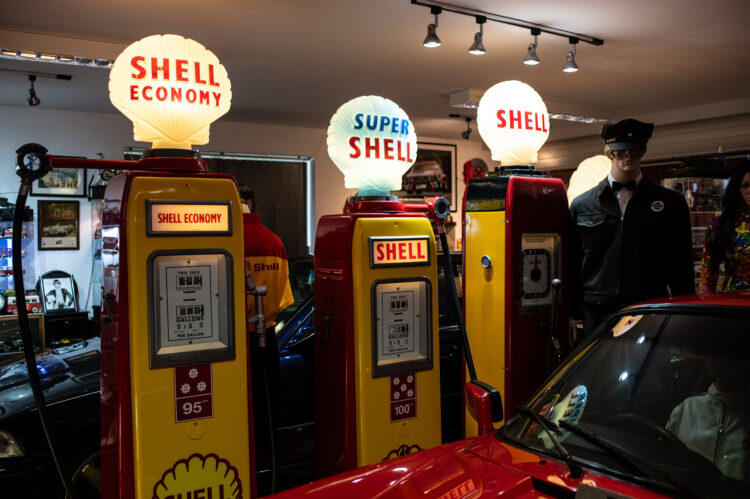
Philip: I think the main thing and obviously the first thing they see is the American jeep. We encourage our visitors to dress up and get into the jeep. At most other collections that doesn’t happen, you don’t have this hands on experience.
They’re allowed to photograph everything, they’re allowed to get into the cars and get their photographs taken as Elvis Presley or George Michael or whoever they want to be, that’s fairly unique.
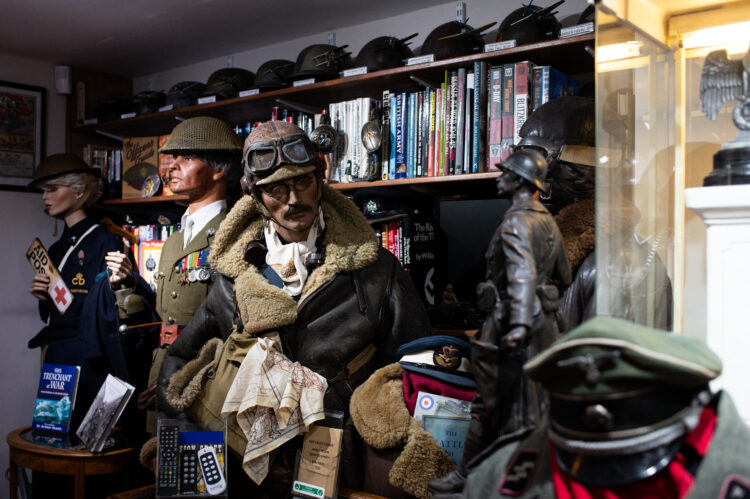
But the main thing, once they get into the military museum, their eyes sort of open wide. We warn them in advance obviously that it’s not this woke culture, it’s the real thing. You’ve got to remember that we’ve got international visitors, people from America, Canada, but you’ve also got people from Poland. We had Dutch visitors last week, French the week before, all those countries were under the control of the Germans for 5-6 years. It’s difficult for some people, and also I don’t know their history. We always prewarn people when they come in that it will effect different people in different ways. It’s fairly well known that I’ve had people in tears as they walk through the door, because they may have lost their father or their grandfather etc. We had people who came through the doors whose grandfathers were in a concentration camp for example, so you always have to think of that, in terms of what those personal stories will be. It’s very rewarding because then they’re experiencing something that they don’t really experience in the big museums, this personal contact, it’s bringing stuff back to them that they don’t really recognise. You’ve always got to be careful with things like flags and war flags and stuff like that, as they are banned throughout other countries. Its very important for kids in particular, I like kids to come here who are over 10. With kids you can start teaching who was there at the time, who were the leaders, what do you think this is or what that was used for, and that’s a good experience. I suppose I’m lucky because I’m a qualified teacher so I can talk to those children at the levels that’s required. The worst thing ever invented is a video game called Call of Duty. These kids are able to machine gun across the Normandy Coast and kill 300 Americans on video games, but then they don’t know who Churchill, Eisenhower or Stalin was. The variation of teaching in schools is enormous, some schools are really good at it, others will bypass the subject or do a completely different period.
Us – The collection attracts visitors from all over the world really Philip, what ‘s the most common feedback you get from your visitors?
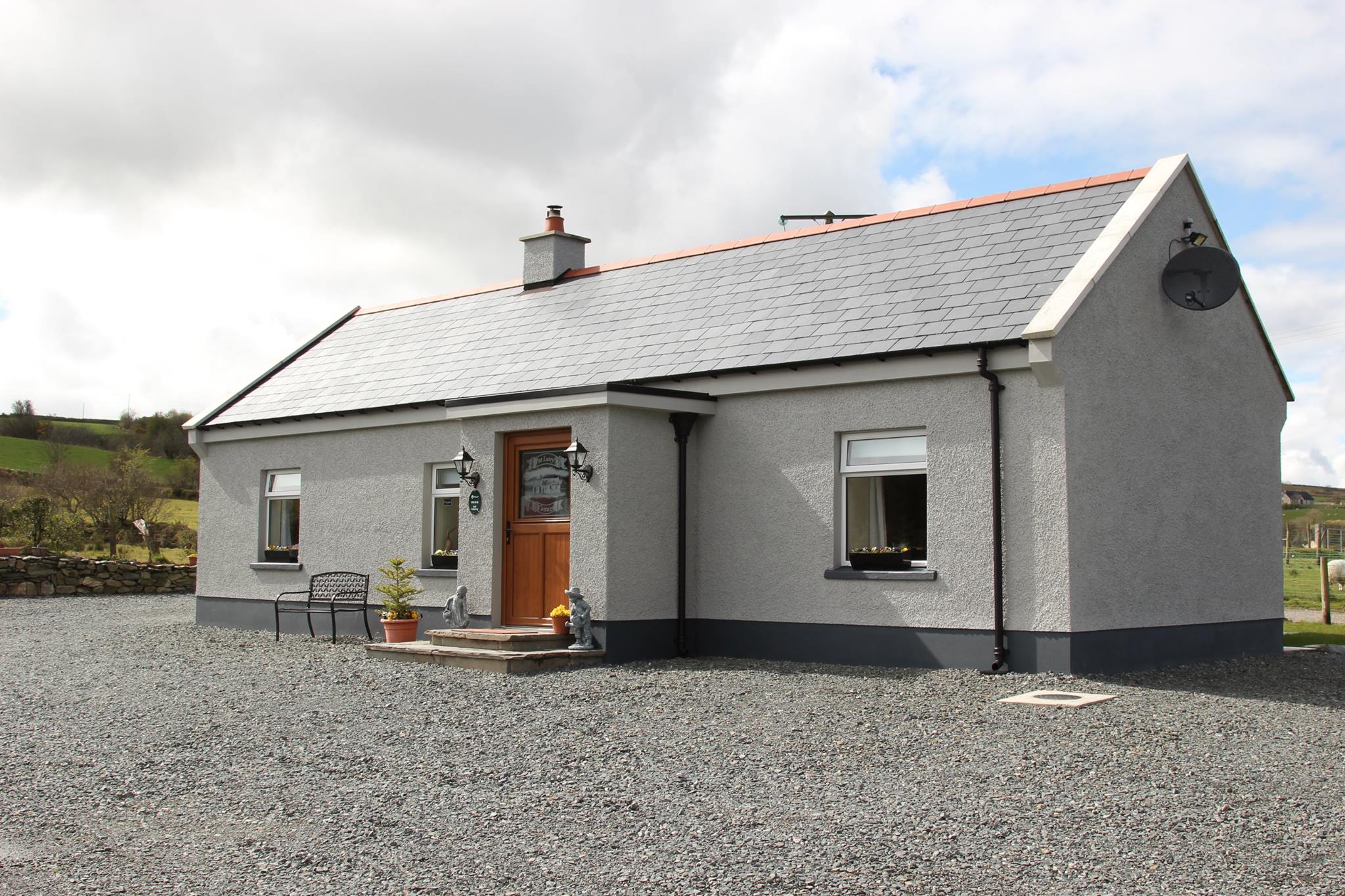
Philip: The words I hear all the time is Hidden Gem, and they’ll come in here, arrive at the door and look at the house and it looks like a bungalow, and think they’re at the wrong place. That happens all the time! They drive past here 20 times and they don’t know this collection exists and then they come in it’s the wow factor. I’ve put quite a considerable amount of expenditure and time into the lighting, the cabinets, to the way the place looks. Whilst visitors can’t touch weapons they can experience sitting in vehicles. Then there’s the memory thing that comes back to them, “I had that then I was a child, I had that radio, look there’s a copy of Judy Annual 1970s, I remember that” that’s the difference. We get a lot of toy collectors here and with over 1000 model cars they know their stuff, they know exactly what that car is and can relate. That’s the rewarding thing, when you get that response. I suppose that’s positive reinforcement to me and that’s why I do it the next day and the next day. Can you imagine getting that endorphin hit every single day, it’s not a job anymore, I enjoy it.
Us – Why do you feel its so important to preserve and share these pieces of history with future generations Philip.
Philip: There’s a very overused quote by Santiago and it says “if you don’t remember the past you’re condemned to repeat it”. We have lost all the veterans from the First World War; we’ve lost most of the veterans from the Second World War – only 4 veterans were at D Day for the commemoration in France this year. They’re now in their late 90s, 100s. If we don’t remember this then we are going to repeat it, now you only have to look at the situation in Palestine, Iran, you know there’s wars throughout the world. Wars are not geared just towards the First and Second World Wars, we’ve had conflicts almost continuously for the last 50 years at some part, be it Vietnam or Afghanistan. So it is really important for me that we remember the past, and if these small collections are broken up and they just go into the ether then there’s something badly wrong. It would be a real shame that this collection is lost to Omagh, but it almost certainly it will be, and you know that always hits me in the back of my mind. I’m 72 now so it’s difficult for me to look 20 years in the future. You always have to think, what’s going to happen next year and the next year. I’m lucky I have some very good friends, you know people who know this stuff inside out, but I would just hate the whole collection to be broken up and lost to the public.
Understandably this has been an emotional question for Philip to answer, this is a lifetime of personal work, emotion and time that has been so lovingly put into this collection, and although it is difficult to see the sadness that it brings to Philip thinking of the collection and it’s future, we feel very honoured and grateful that we have been given the opportunity to hear his story and the story of one of the greatest collections of war and vehicle memorabilia that this country holds first hand.
Us – As well as military history the collection obviously has the model cars and enamel signs and juke boxes and so on, how important do you think is that variety of items in creating the visitor experience?
Philip: Well that’s why I think this is unique – you won’t get this even in England. You’ll certainly get a motor museum with 100 cars in it, and you’ll get a military museum with 30,000 pieces in it, but you won’t get that mixture and because we’re always hands on and have a fully guided tour then they are experiencing a very personalised tour. From that aspect it’s very important to me. Some people that come here are not military collectors, they’re people who grew up with dinky toys, they grew up with Barbie or Sandy Dolls, and they get to relive that childhood experience and that means so much to me – the reaction you get when they see these things and the memories they bring back.
We had a few very rewarding experiences recently where we had people with Alzheimer’s here. There were three wheelchair users from a care home and one of them couldn’t communicate. He then picked up a few items, and as soon as he picked up those items he was able to name them, because he’d remembered it. Simply by picking up that item he then started to talk about it, and that means an awful lot.
You get that with music – when we visit nursing homes we often play music, and you’ll get somebody starting to sing. It could be something like “Me and Bobby Magee” or something like that and it just triggers the memory and they start to sing.
The volunteers that we have now are superb. They have learned that it’s nothing to do with that artifact that’s in front of them, its all to do with how they deal with the personal interaction. They’ve got to be able to speak to those individuals, to joke with them to talk about the artifact etc.
Us – The Abingdon Collection is one of Omagh’s Hidden Gems as we know, what role do you think attractions like yours play in encouraging people to visit and spend time in the area?
Philip: Well I’ve been involved with Sperrin Tourism for 40 years and the one thing that always was a bug bearer is the selling point of the Sperrins, and why would people come to the Sperrins rather than go to Newcastle or Portrush or wherever else. It’s always been the situation, you hear it all the time that people will come to the Ulster American Folk Park in a bus and they’ll move on to Derry/Londonderry or on to Enniskillen. The only way I think that can be resolved is if it’s targeted towards the smaller coaches – the 12 and 15 seaters. The focal point for me is that if they come to the Abingdon Collection I advise them that they do the Folk Park in the morning and us in the afternoon – a dual approach between the two or vice versa. Then we send them to the Gortin Glen Forest Park etc. It’s the knock on effect that we have, its where they eat, where they stay, where they visit next and that’s why particularly for us as a small attraction, we rely heavily on the B&Bs, the Glamping sites or the hotels, its that secondary spend that’s so important to the region.
Us – Following on from that Philip, how have you seen tourism in Omagh and the wider district evolve during your time running the collection here?
Philip: Well I can only go on the income to Cancer Research, and that has been incredibly successful in terms of an upward spiral in donations going to the charity from visits Covid obviously hit us, not as bad as perhaps other organisations, but from then on we’ve been going up probably 15/20% every year. I think that’s a very positive thing. I think first of all I have to say Explore Omagh Sperrins has made a difference – it definitely helped us dramatically. I don’t promote very much – I don’t promote on social media much but that exposure helped us dramatically at the early stages, and the likes of this interview will defiantly help because people are looking at your site interested in a visit.
Us – Is there any particular visitor story or experience that has stayed with you over the years Philip, anything memorable happen?
Philip: Yes, we’ve had a few incidents, but the one that I suppose I quote the most is if you go into the museum here there’s a lot of mannequins, a lot of uniforms, and one of the first people through the doors went into the museum and they turned to the left and immediately burst into tears. I couldn’t understand this at all, I’m not going to name the name but the unform that was standing to her left was her uncles. She hadn’t seen that uniform in 35 years. Her uncle was one of the most well-known regimental Sergeant Majors in Ireland. He served with the Kings Dragoon Guards. We had only just opened the collection and that immediately resulted in a personal touch between her and this uniform standing beside her. She wasn’t aware that it was part of the collection – she explained to me that it was her uncles as she recognised the uniform and the medals. She knew what’s called the Stable Belt and that has always stuck with me, it was a very special memorable moment.
You get people who are emotional for various reasons. Very often someone will just burst into tears because a memory has been reignited with them of a loved one maybe no longer with them, and that’s not just in the military end, it happens in the cars and stuff too, small things ignite memories.
Us – For someone considering a visit why should the Abingdon Collection be on their list when they’re in Omagh?
Philip: Because they’re not going to find this anywhere else, it’s a personal tour. They listen to me for an hour and forty minutes, but it’s a two-way conversation. I get knowledge from them and they get knowledge from me. I pick something up every day from people arriving here. But the main thing I suppose is when they go through those doors is they don’t know what to expect, the expectation then changes to that wow factor, I see it every single day, there’s nobody leaves here feeling underwhelmed. They’ll always say I’ve never seen anything like it, and that’s from visitors from all over the world, who’ve been to the biggest museums in the world.
Us – Finally Philip, after a lifetime of collecting and preserving history what does the Abingdon Collection mean to you personally.
Philip: I suppose it’s a life story in many ways…From that initial bayonet to where we are today. It’s that growth that has happened within the collection. It’s the fact that every item has a personal connection as well, so if I lift any item up, I may not remember where I bought the item but I know exactly what it is, and it has a relevance. Everything has a reaction, and that’s what people love and that’s why it’s so important that these collections exist, it’s such a general collection, but everything has its place.
As our conversation came to an end, one thing was abundantly clear: while the Abingdon Collection bears Philip’s name and reflects his incredible passion, it has never been a journey he has taken alone. Throughout the interview, Philip was quick to acknowledge the unwavering support of his wife, Hazel, whose encouragement, patience and countless hours of hard work behind the scenes have played an invaluable role in helping the collection become what it is today. Every great collection has a story, and behind this one is a partnership that has quietly made it all possible.
We genuinely believe this interview is an important piece of history in its own right. Philip has dedicated a lifetime to preserving, researching and sharing thousands of artefacts, ensuring that the stories behind them are never forgotten. His passion reminds us that history is not simply about objects – it is about people, memories and the lessons they carry forward.
If, in some small way, this interview helps preserve Philip’s own story alongside the remarkable collection he has built, then we are proud to have played a part. Long into the future, when others discover the Abingdon Collection and the extraordinary legacy it represents, we hope they will also have the opportunity to understand the dedication, emotion and vision of the man who made it possible, and the support of Hazel, who stood beside him every step of the way.